|
Getting your Trinity Audio player ready...
|

Nothing says “Happy Valentine’s Day” like a story about the end of the world.
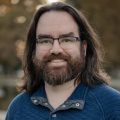
Although there are romance subplots, San Ramon author Greg Le Sage’s debut novel is really more about the gravity and tension its grabber title implies: “Quantum Eschaton”.
“The story explores themes of trust, ambition and the ethical perils of advanced technology in a shadowy, high-stakes world,” Le Sage told me in an email interview over the weekend.
“Eschaton means the final event in the divine plan … A synonym is day of judgment. The story is about the calamity produced by the advent of quantum computing used by bad actors,” said Le Sage, whose day job is engineering at Stanford University.
“A lot of people need to look it up,” he added. “I think it’s beneficial to read the title and ask at first, ‘What does that mean?’ I think it’s a good hook.”
A cyber-thriller that was published in October, “Quantum Eschaton” centers on the aftermath of engineer James Cathcart — “brilliant yet socially isolated,” as Le Sage put it — making a groundbreaking discovery in quantum computing.

“His achievement catches the attention of Seth, a charismatic but morally ambiguous executive, who manipulates James into a dangerous plan,” the author explained. “Seth convinces James to steal the technology, promising wealth and luxury. Together, they orchestrate a heist, using James’s quantum breakthrough to steal £100 million from the Bank of England.”
“They leave the US and try to sell quantum computing to the highest bidder. Potential customers include China, Russia and North Korea,” Le Sage said. “As the plot unfolds, James grapples with moral dilemmas, manipulation and his longing for acceptance, while Seth’s calculated leadership steers them closer to the point of no return.”
“The heist’s repercussions are far-reaching, igniting suspicion, global scrutiny and the realization that quantum technology could upend society’s most secure systems,” he added. “James, a tragic figure desperate for recognition and belonging, becomes an unwilling pawn in a dangerous game of power and betrayal.”
For Le Sage, who also worked at Lawrence Livermore National Laboratory from 1997 to 2007 and then spent 16 years with the CIA’s chief scientist, the story idea sparked from his observations at the federal SLAC National Accelerator Laboratory at Stanford.
“In the last four years, two top engineers were hired away by Amazon and Google. I understand that their salaries were doubled,” he said. “It made me think about how companies would use the talents of top scientists. Scientists at SLAC want to make discoveries. Companies want to make money.”
He began to mold the story in script-writing classes through UCLA, his alma mater. After realizing the chances of selling a screenplay were slim, he switched the concept into a novel.
“My daughter, who is a professional writer, suggested a few plot twists that I added,” Le Sage said. “I found a company in India with an editor who helped me clean up parts of the story. They also helped me create the eBook format that I uploaded to Amazon. For not much money I produced a book.”
Le Sage is now working with a publications firm to promote “Quantum Eschaton” and get hardcover copies released. He’s also fleshing out an idea for his next book.
“I am writing a new story about artificial intelligence in the future. My character has a personal AI assistant who talks him into becoming a hitman,” he told me.
Editor’s note: Jeremy Walsh is the editorial director for the Embarcadero Media Foundation’s East Bay Division. His “What a Week” column is a recurring feature in the Pleasanton Weekly, Livermore Vine and DanvilleSanRamon.com.
Most Popular
 Housing, RVs and Trump take center stage at Mountain View City Council candidate forumOctober 9, 2026 2:11 pm
 Candidate Comparison Grids: Mountain View Whisman School District Board of TrusteesOctober 5, 2026 12:47 pm